

How to Treat Chronic Dry Skin and Rebuild Your Barrier
Last Updated: October 26, 2026
Quick Summary
To treat chronic dry skin, moisturize within three minutes of patting dry while skin is still damp, then layer a humectant, emollient, and occlusive to seal water in. Keep showers to five to ten minutes in lukewarm water, use fragrance-free cleansers, and reapply a thick balm to the driest areas each evening.
- Apply moisturizer within three minutes of patting dry, while skin still feels cool and slightly damp.
- Keep showers to five to ten minutes in lukewarm water to protect the skin barrier.
- Layer products thinnest to thickest: a humectant serum first, then a cream or balm over it.
- Seal deep cracks with an occlusive balm and cover overnight with socks or a soft wrap.
- See a dermatologist if home care for several weeks brings no improvement or cracking bleeds.
Table of Contents
- Why Chronic Dry Skin Keeps Coming Back
- Chronic Dry Skin Causes You Can and Cannot Control
- A Step-by-Step Daily Routine for Chronic Dry Skin
- Dry Skin Treatment at Home: Bathing, Water Temperature, and Humidity
- How to Pick the Best Moisturizer for Sensitive Dry Skin
- Gentle Cleansing and Reducing Itch and Irritation
- Managing Cracks, Bleeding, and Severe Itch
- When to See a Dermatologist for Dry Skin
- Building a Routine That Prevents Flare-Ups
- Choosing Balms and Oils for Very Dry Skin
- Frequently Asked Questions
Why Chronic Dry Skin Keeps Coming Back
Chronic dry skin is a persistent condition in which the skin barrier fails to hold moisture, leaving skin rough, tight, flaky, and often itchy long after a single moisturizer application. People often treat the surface, the flaking improves for a day, and then it returns. The reason is simple. Dry, cracked skin has a compromised barrier, and until that barrier is repaired, moisture escapes as fast as you add it. Below, you’ll find guidance on building a routine focused on skin barrier support rather than only temporary relief. The tallow benefits and myths guide is worth reading if you are weighing tallow-based products for this job.
Chronic Dry Skin Causes You Can and Cannot Control
Chronic dry skin causes fall into two buckets: external triggers you can change and internal factors you cannot. Separating them matters because most people spend effort on the wrong one. You can adjust your bathing habits, your home humidity, and your products. You cannot change your age, your genetics, or a medication your doctor prescribed. A common mistake is blaming a cream for dryness caused by a fifteen-minute hot shower.
Environmental and Seasonal Triggers
Low humidity is the biggest external driver. Winter weather, indoor heating, and desert air all pull water from the skin. Irritating fabrics like wool and harsh detergents compound the problem. If dry climate is your main trigger, our desert skincare guide covers the specific adjustments that help.
Health and Medication Factors
Some skin dryness traces to health conditions such as thyroid disorders, diabetes, or eczema, and some medications list dryness as a side effect. Age also plays a role, since oil production declines over time. These factors are not self-diagnosable. If your dryness started suddenly or came with a new prescription, that is a conversation for your doctor.
A Step-by-Step Daily Routine for Chronic Dry Skin
Most dry-skin advice is a pile of separate tips. What actually controls chronic dryness is the order and timing of a small number of steps, repeated every day. The routine below is built around one principle: never let the barrier fully dry out between applications. Moisturizer applied to dry skin sits on top of dead cells; moisturizer applied to damp skin pulls that water in and then seals it there.
Morning
- Rinse or skip the cleanser. If you showered the night before, a plain lukewarm rinse is enough for most people. Save the gentle cleanser for areas that actually get oily or dirty.
- Apply moisturizer within three minutes of patting dry. Skin should still feel cool and slightly damp. This is the single highest-leverage habit in the whole routine.
- Layer, thinnest to thickest. A humectant serum or lotion first, then a cream or balm over it. The humectant draws water in; the thicker layer keeps it from escaping.
- Spot-treat hands, knuckles, and elbows with a balm before you leave the house. These areas lose moisture fastest and are exposed all day.
Bathing (Evening)
- Keep the shower to five to ten minutes in lukewarm water. Hot water feels good and strips oil fast; the tightness afterward is the barrier telling you it lost ground.
- Cleanse with a fragrance-free, sulfate-free wash, and only where needed. Squeaky-clean skin is stripped skin.
- Pat, do not rub. Friction on damp skin damages the barrier further.
- Moisturize before you leave the bathroom. The humidity in the room is working for you; use it.
Evening
- Reapply the thick layer to the driest areas: shins, forearms, hands, and any patches that crack.
- Seal deep cracks with an occlusive balm and cover overnight with socks or a soft wrap if the area is on a foot or hand.
- Run a humidifier in the bedroom during heating season so the barrier is not fighting dry air for eight hours.
Why the Order Matters
The sequence mirrors how the barrier works. Water softens the outer layer and makes it receptive; humectants hold water in that layer; emollients smooth the surface; occlusives form the seal on top. Skip the damp-skin step and the rest of the routine is working against dry air. Skip the occlusive and the water you added evaporates within the hour. The routine is short on purpose: a plan you will actually repeat twice a day beats an elaborate one you abandon by Thursday.
Dry Skin Treatment at Home: Bathing, Water Temperature, and Humidity
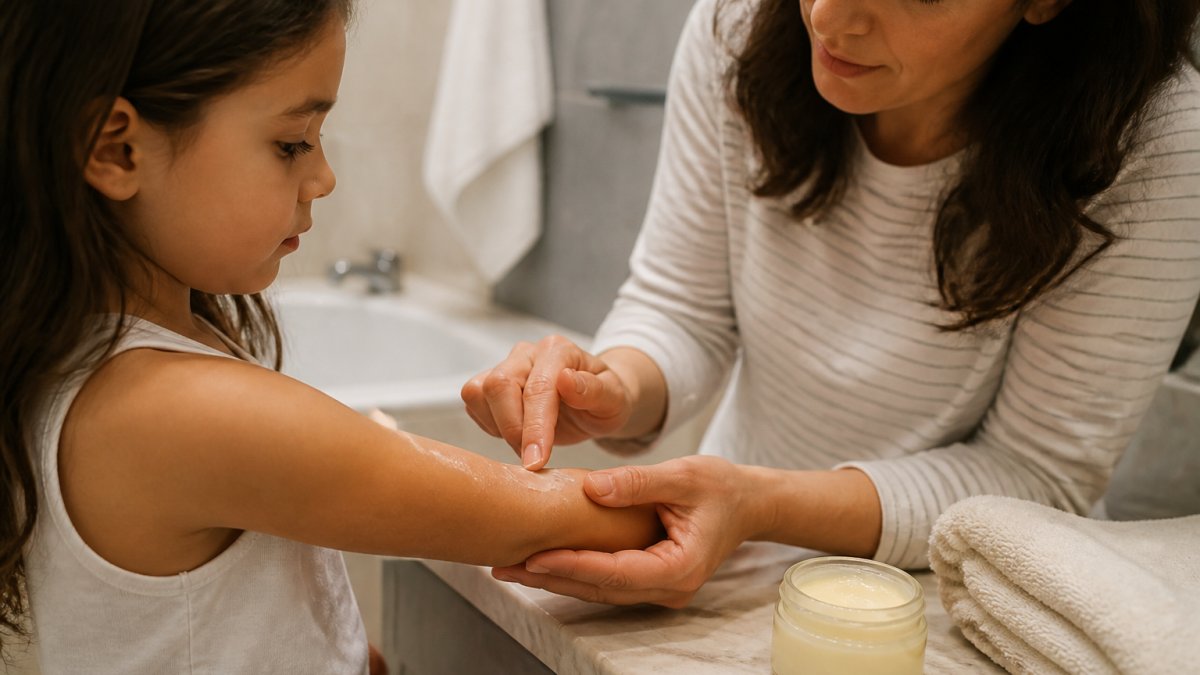
Dry skin treatment at home starts with water. Short showers in lukewarm water, capped around five to ten minutes, protect the skin barrier far better than long hot soaks. Hot water strips oils quickly, and the temporary warmth is not worth the rebound tightness. Add a humidifier to bedrooms in winter, and consider an oatmeal bath for itchy skin. Bathe less often if you can, and skip bubble baths and heavily fragranced soaks entirely.
How to Pick the Best Moisturizer for Sensitive Dry Skin
The best moisturizer for sensitive dry skin is the thickest formula you will actually use consistently, built on fragrance-free ingredients that both add water and hold it. Format matters more than brand: ointments and balms seal best, creams sit in the middle, and lotions are the weakest choice for chronic dryness because they are mostly water and evaporate quickly. For sensitive skin, patch test anything new on the inner forearm for two or three days before using it on the face or large areas.
Match the Ingredient to the Problem
| What you need | Ingredient family | Examples | How it works |
|---|---|---|---|
| Add water to dry skin | Humectant | Glycerin, hyaluronic acid, urea | Draws water into the outer layer |
| Soften rough, flaky patches | Emollient | Shea butter, coconut oil, fatty alcohols | Fills the gaps between skin cells |
| Seal moisture in | Occlusive | Petroleum jelly, beeswax, dimethicone | Forms a barrier that slows water loss |
| Rebuild a damaged barrier | Barrier lipid | Ceramides, cholesterol, fatty acids | Replaces the lipids chronic dryness depletes |
A formula that combines all four families outperforms any single-ingredient product. If your skin is very dry, look for ceramides plus petrolatum or beeswax near the top of the ingredient list. If your skin is sensitive and reactive, fragrance and essential oils are the most common culprits, so choose fragrance-free versions even when the scented one smells better.
Format Trade-Offs
- Ointments and balms are the strongest seal and the best choice for cracks, heels, elbows, and overnight use. They feel heavy and can be greasy, which is why many people only use them at night.
- Creams are the practical everyday choice: thick enough to matter, light enough to wear under clothes and makeup.
- Lotions are fine for normal skin and for hairy areas, but for chronic dryness they usually need a cream or balm layered over them.
For sensitive skin, patch test anything new on the inner forearm for a few days. The [American Academy of Dermatology offers guidance on moisturizer selection | aad.org] that aligns with what we recommend to families.
Ingredients That Help Skin Retain Moisture
Three ingredient families do most of the work. Humectants such as glycerin and hyaluronic acid draw water into the skin. Emollients like shea butter and coconut oil soften and smooth. Occlusives such as petroleum jelly and beeswax trap moisture in. Ceramides rebuild the barrier itself. A formula combining all three outperforms any single-ingredient product.
Gentle Cleansing and Reducing Itch and Irritation
Gentle cleansing means skipping harsh soaps, sulfates, and anything that leaves skin squeaky. That squeaky feeling is stripped oil, not cleanliness. For itch relief, keep nails short, moisturize the itch instead of scratching, and wear loose-fitting clothes in soft fabrics. A gentle foaming oil cleanser can be helpful for exactly this step: it cleans without leaving the barrier stripped, which matters when irritation is already high.
Managing Cracks, Bleeding, and Severe Itch
Cracked, bleeding skin needs more than lotion. Seal deep cracks with a thick occlusive balm, cover them overnight, and keep the area clean. Watch out: cracks that are hot, spreading, or oozing can signal infection and need medical care, not another cream. Severe itch that disrupts sleep is also a reason to escalate. Do not scrub or exfoliate cracked skin, no matter how tempting the flaking looks.
When to See a Dermatologist for Dry Skin
See a dermatologist for dry skin when home care for several weeks brings no improvement, when cracking bleeds or shows infection signs, or when dryness comes with rash, swelling, or spreading itch. Persistent symptoms despite a solid routine point to an underlying condition such as eczema or psoriasis. The [National Eczema Association explains when symptoms warrant professional evaluation | nationaleczema.org], and we would add one more trigger: any sudden change in your skin alongside a new medication.
Building a Routine That Prevents Flare-Ups
Prevention comes down to consistency, not intensity. Moisturize several times a day, keep showers short, run a humidifier, and avoid known triggers. Track what precedes each flare so patterns emerge. Treating chronic dry skin is a maintenance job, and the people who do best are the ones who never let the barrier fully break down in the first place.
Choosing Balms and Oils for Very Dry Skin
Balms and oils are the heaviest tools in the kit, and very dry skin usually needs them. A balm with beeswax and butters seals cracks and rough patches; a body oil layers well under or over a cream for extra slip. For sealing moisture into very dry skin, our Tallow Body Balm is formulated with grass-fed beef tallow, shea butter, and manuka honey for rough patches and daily body care. If you prefer an oil, our Manuka Honey & Sea Moss Body Oil is a lighter option for daily use. Both are priced at $39.97 and $29.97 respectively, and both are suitable for the whole family.


| Product | Format | Best For | Price |
|---|---|---|---|
| Tallow Body Balm | Thick balm | Rough patches, cracks, overnight sealing | $39.97 |
| Manuka Honey & Sea Moss Body Oil | Lightweight oil | Daily body use, after shaving | $29.97 |
| Grass-Fed Whipped Tallow | Whipped balm | Full-body daily moisture | $27.54 |
| Riche Crème | Face cream | Facial dryness and barrier support | $59.00 |
Chronic dry skin rarely resolves with a single product. Our formulas combine grass-fed tallow, peptides, manuka honey, and botanical oils to deliver deep moisturization for very dry skin and support the barrier over time. Every product is curated by an Integrative Nurse Practitioner and made for the whole family. Get started with Bloomfield Bath and give your skin the consistent, barrier-first care it has been missing.
Frequently Asked Questions
Why is my skin so dry even when I moisturize every day?
Daily moisturizing only holds if the skin barrier is intact and you are not stripping it faster than you replace it. Hot showers, harsh soaps, low indoor humidity, and fragranced products all break down the barrier, so the cream you apply evaporates instead of staying in. Apply moisturizer within three minutes of patting skin dry, use lukewarm water, and switch to a gentle cleanser. If dryness persists after two to three weeks of that routine, look at chronic dry skin causes such as medication side effects or an underlying condition.
How often should I moisturize chronic dry skin?
Twice a day is the baseline: once after bathing and once before bed. For very dry skin, add a third application on hands, elbows, knees, and any area that feels tight. Thick moisturizers such as balms and ointments hold longer than lotions, so you may need fewer reapplications. Keep a small jar at your desk or in your bag so you can reapply after washing your hands, which is one of the most common reasons hand dryness never resolves.
What ingredients should I look for in a moisturizer for sensitive, dry skin?
Look for a short ingredient list built around humectants and occlusives. Glycerin and hyaluronic acid pull water into the skin; ceramides, shea butter, beeswax, and petroleum jelly seal it in. For sensitive skin, skip added fragrance and essential oils where you can, and patch test anything new on your inner forearm for 48 hours. Formulas built on grass-fed tallow, manuka honey, and botanical oils combine fatty acids with humectant ingredients for a rich, nourishing feel on very dry skin.
Does drinking more water help dry skin?
Staying hydrated supports overall health, but drinking extra water alone does not fix chronic dry skin. The problem is usually a compromised skin barrier losing water to the environment, not a body-wide fluid shortage. You get more visible improvement from sealing moisture in with a thick moisturizer, running a humidifier in winter, and cutting shower time and temperature. Treat water intake as background support, not the treatment.
When should I see a dermatologist about persistent dry skin?
Book an appointment if dryness lasts more than two to three weeks despite a consistent routine, or if you see cracking that bleeds, oozing, spreading redness, or warmth, which can signal infection. See a dermatologist promptly if itching disrupts sleep, if the dryness comes with a new rash or scaling patches, or if it started after a new medication. These signs point to conditions such as eczema or psoriasis that need prescription treatment rather than drugstore moisturizer.
Can dry elbows be caused by vitamin deficiencies?
Rough, cracked elbows are far more often caused by friction, pressure, and infrequent moisturizing than by a vitamin deficiency. That said, deficiencies in vitamins A, B, or essential fatty acids can contribute to dry, scaly skin in some people. If you have widespread dryness alongside fatigue, hair changes, or a restricted diet, ask your doctor about testing. For most people, exfoliating gently and applying a thick balm nightly resolves elbow dryness within a couple of weeks.

